Blood Patch Overview
Blood patch is indicated on an individual case basis if there is no improvement, or there is a deterioration, after a reasonable conservative trial and symptoms are significantly limiting the patient’s activity. If symptoms are very severe, blood patch might be the first line of treatment:
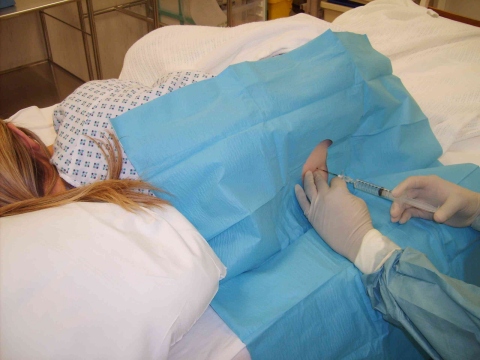
Decision
A senior clinician should be involved in the decision, and the options should be explained to the patient.
Mechanism
How does blood patching work?
Blood patching has been studied using radiolabelled blood and MRI scanning. There appear to be two components to its effectiveness:
First - the injected blood spreads cephalad and caudally, circumferentially and into the paravertebral space, via the intervertebral foramina. The thecal sac is compressed; this is presumed to cause rapid resolution of headache. However, this compression is not sustained.
Second - as the blood clots, this is presumed to prevent further CSF leakage.
Risks
Risks include:
- Most of the usual risks, including nerve damage and further dural puncture, but evidently not those associated with the epidural local anaesthetic
- Risk of failure: around 70 % of blood patches are successful. In the case of failure, it is possible to repeat blood patch, with a similar success rate
- Risk of recurrence: even if initially successful, PDPH may recur
Contraindications
Most of the usual contraindications to epidural apply. In particular, one should exclude coagulation abnormalities and systemic sepsis.