Overview
Flow (Q) results from a difference in pressure (P1–P2) - this can occur from either an upstream rise or a downstream fall in pressure. Resistance (R) represents the barrier to flow created by the conducting pathway (Fig 1).
The most efficient type of flow is laminar, in which fluid layers move smoothly over each other. Under laminar conditions flow can be calculated from Poiseuille’s formula.
Question 1: What equation links pressure, flow and resistance?
Click here for answer.
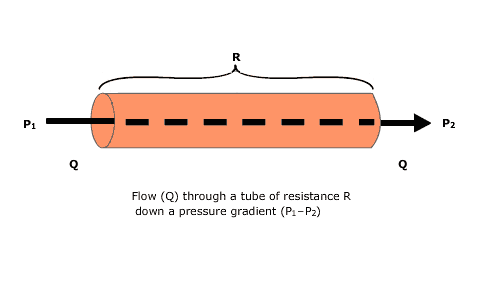
Flow (Q) results from a difference in pressure (P1–P2) - this can occur from either an upstream rise or a downstream fall in pressure. Resistance (R) represents the barrier to flow created by the conducting pathway (Fig 1).
The most efficient type of flow is laminar, in which fluid layers move smoothly over each other. Under laminar conditions flow can be calculated from Poiseuille’s formula.
Question 1: What equation links pressure, flow and resistance?
Answer: Pressure = Flow x Resistance
Question 2: What are the equivalent values for the circulation?
Click here for answer.
Flow (Q) results from a difference in pressure (P1–P2) - this can occur from either an upstream rise or a downstream fall in pressure. Resistance (R) represents the barrier to flow created by the conducting pathway (Fig 1).
The most efficient type of flow is laminar, in which fluid layers move smoothly over each other. Under laminar conditions flow can be calculated from Poiseuille’s formula.
Question 1: What equation links pressure, flow and resistance?
Answer: Pressure = Flow x Resistance
Question 2: What are the equivalent values for the circulation?
Answer: BP = CO x SVR
BP = Blood Pressure
CO = Cardiac Output
SVR = Systemic Vascular Resistance