The national colour-coding for labels on syringes containing non-depolarizing NMBs is red. Vecuronium (Fig 1) and atracurium (Fig 2) are the two of the most commonly used non-depolarizing muscle relaxants. You should be familiar with these for your initial test of competence.
Succinylcholine (Fig 3) has a black and red label to show that it is a depolarizing rather than a non-depolarizing NMB.
Vecuronium and atracurium are more potent than succinylcholine in producing muscle relaxation, despite succinylcholine having a more rapid onset of action.
Intubating doses are based on body weight while maintenance doses are titrated according to response determined by the peripheral nerve stimulator.
All the doses given here are for an adult patient; you are not expected to know about paediatric doses for your initial test of competence.
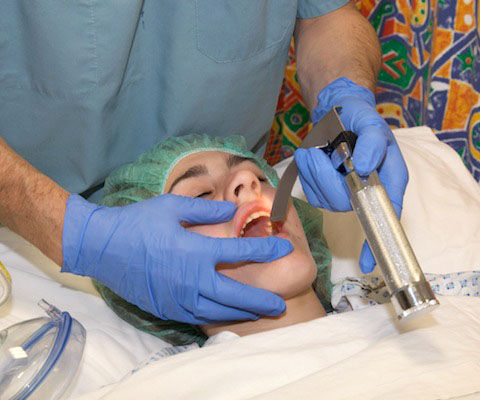
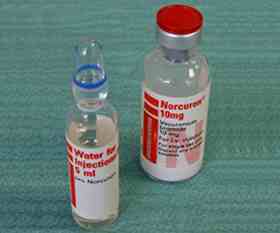
Fig 1 Vecuronium
Presentation
Glass vial with 10 mg powder to be mixed with accompanying vial containing sterile water. Standard concentration 2 mg/ml.
Dose
0.1 mg/kg
Maintenance Dose
1-2 mg
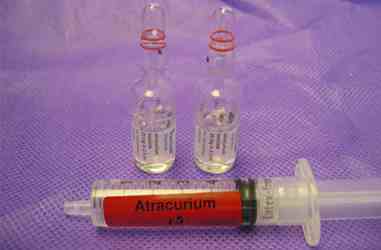
Fig 2 Atracurium
Presentation
2.5 ml and 5 ml ampoules containing 10 mg/ml.
Intubating Dose
0.5 mg/kg
Maintenance Dose
10-20 mg
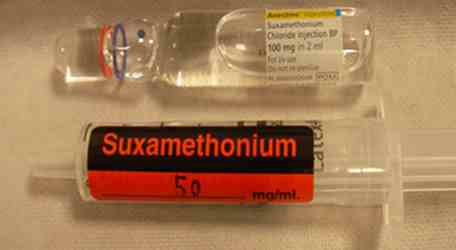
Fig 3 Succinylcholine
Presentation
2 ml glass vial, 100 mg total.
Intubating Dose
1-2 mg/kg
Succinylcholine should not be used to maintain neuromuscular blockade.